From Warehouse to Customer: Where Most Fulfillment Breaks Down
April 28, 2026·3 min read
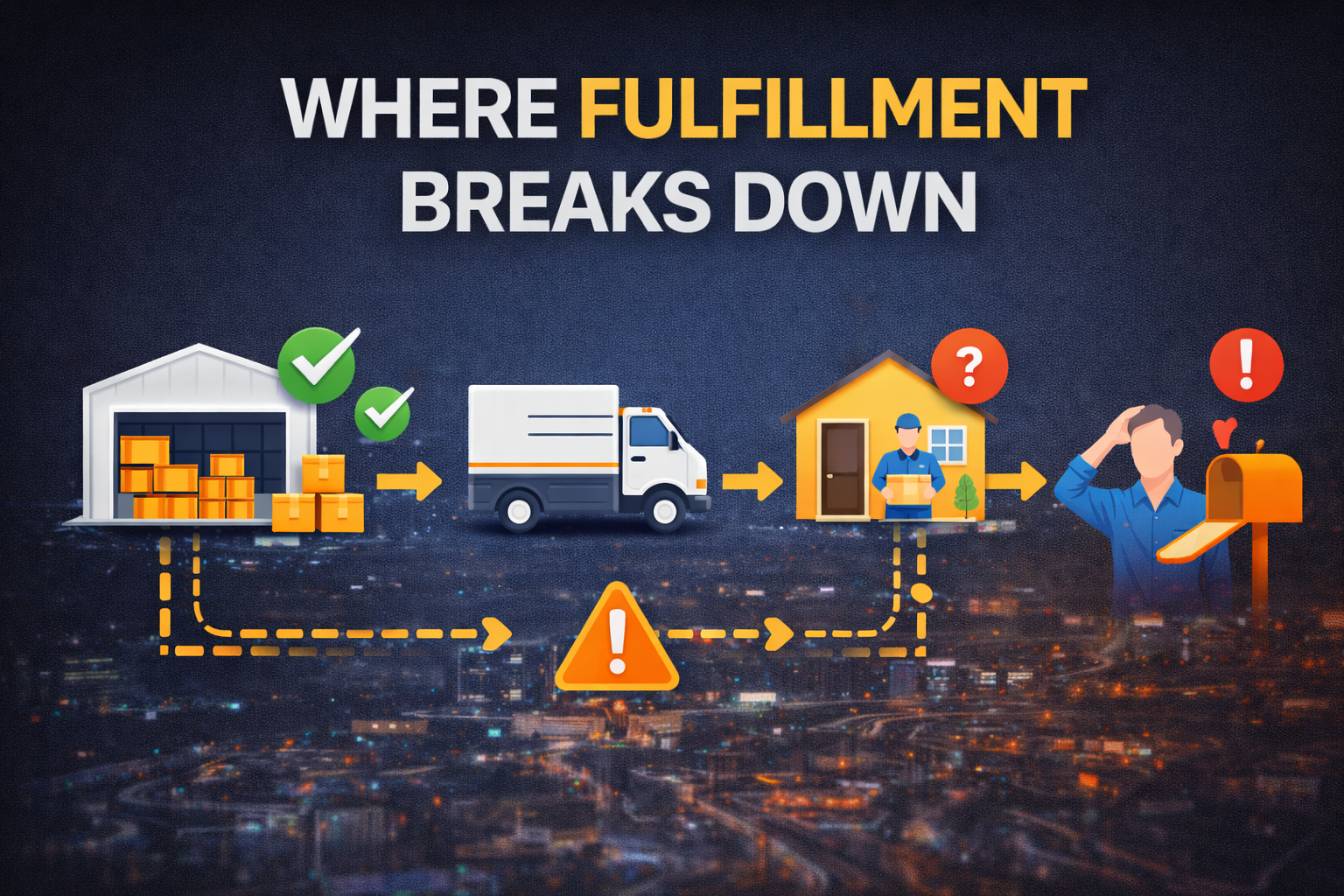
Most fulfillment doesn’t fail in the warehouse, and it also doesn’t fail at the customer’s door. But it fails somewhere in between.
That invisible stretch — from dispatch to delivery — is where the real complexity lives. And for many businesses, it’s where margins quietly erode and customer experience delivery dissatisfaction.
The Illusion of “Ready to Ship”
Inside the warehouse, everything looks under control - Inventory is picked, orders are packed, and labels are printed.Operationally, it feels like success. But “ready to ship” is not the same as ready to deliver.The moment a package leaves the warehouse, control begins to fragment.
The Handoff Problem
Fulfillment usually breaks at the handoff point. The handoff point is between:◆Warehouse → carrier◆Carrier → regional hub◆Hub → last-mile driverThe break usually occurs because each transition introduces:
- Data gaps
- Delays
- Miscommunication, and even
- Accountability ambiguity
No single failure stands out. But collectively, they eventually create inconsistency. Many companies believe tracking solves the problem, but it doesn’t.
Tracking tells you where the parcel is. It doesn’t tell you:
- Why it’s delayed
- What will happen next, and how to fix it.
Visibility without intervention is observation — not control. So, by the time a package reaches last mile, most of the outcome is already determined.
Poor upstream decisions have now led to:
> Inefficient route density
> Missed delivery windows
> Overloaded drivers, and failed delivery attempts
The Real Culprit: Disconnected Systems
Most fulfillment failures are not operational, but systemic.
Common issues:Warehouse systems not aligned with routing logicOrder promises not aligned with delivery capacityInventory placement not aligned with demand geographyReturns not feeding back into planningEach function works, but they don’t work together. And Last mile doesn’t create the problem, It reveals it!
What High-Performing Operations Do Differently
They don’t treat fulfillment as separate stages. Rather they design it as one continuous system:Inventory placement aligned with delivery zonesRouting considered at the point of orderReal-time feedback loops between warehouse and deliveryException handling built into workflowsThe operators' goal shifts from “Ship fast” → to “deliver reliably”
Where SMEs Struggle Most
For SMEs, the breakdown is sharper because:They have fewer resources to absorb inefficienciesGreater dependence on third-party carriersLimited system integration, andRapid growth without operational redesignAnd if these breakdowns continue unchecked, they can lead to a good warehouse performance with Poor delivery experience, and unhappy customers.
The Strategic Shift
Excellent fulfilment center management is not just about faster parcel picking and labelling in big warehouses. It’s about flow alignment - Inventory → order → dispatch → route → delivery.
When that flow is connected:Costs stabilizeDelivery performance improvesCustomer satisfaction and trust also increase
Final Thought
Customers don’t experience your warehouse. They experience your delivery. And by the time something goes wrong, it’s already too late to fix it.The companies that win are not the ones that ship the fastest, but the ones that design fulfillment systems that don’t break in between
Enjoyed this nugget?
Explore more freight-tested insights and logistics stories.