Last Mile, First Impression
February 18, 2026·3 min read
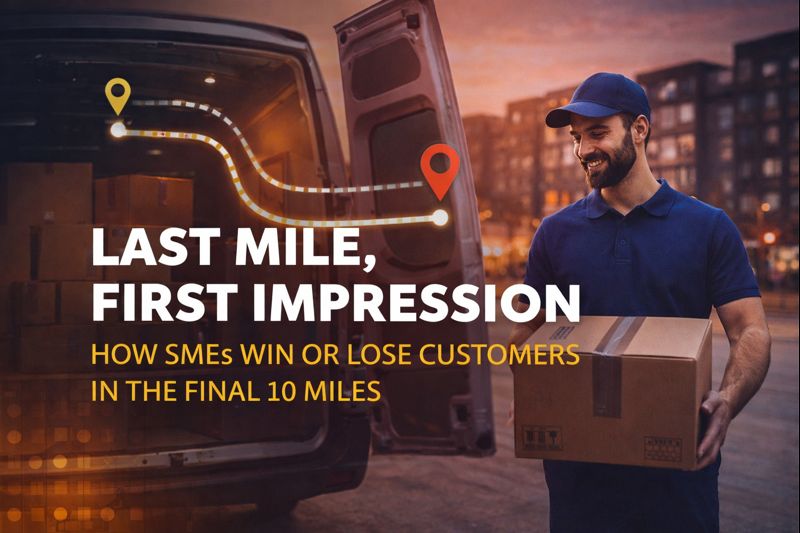
For many customers, the last mile is the only part of your logistics operation they ever experience. They don’t see your dispatch board, your routing decisions nor the daily trade-offs your team makes. They see one thing: Did the delivery arrive when and how it was promised?
In last-mile delivery, operations are not behind the brand. They are the brand.
The SME Reality of the Last Mile
For large enterprises, last-mile inefficiency is an optimization problem. For SMEs, it’s an existential one. This is because every extra kilometer driven, every missed time window, every poorly sequenced route quietly compounds:
- Thinner revenue margins.
- Driver fatigue and burnout.
- Higher fuel and maintenance costs.
- Eroding customer trust.
Unlike large fleets, SMEs don’t have the luxury of inefficiency hiding in scale.
Route Planning: The Motherboard of Last-Mile Delivery
Route planning used to be about finding the shortest path. Today, it is about managing cost, time, and expectations at the same time.
Customers now expect:
- Accurate ETAs
- Real-time updates
- Narrow delivery windows
- Consistency over excuses
That means route planning must account for:
- Traffic patterns and congestion
- Delivery density and stop sequencing
- Vehicle capacity and load mix
- Driver hours and fatigue
- Fuel cost and time trade-offs
Route Optimization Software: A true aid
For SMEs operating in last-mile delivery, route optimization software is no longer a “nice-to-have.” It is a much needed control system for an excellent servic
Good route optimization tools help SMEs:
- Reduce total distance driven
- Improve on-time delivery performance
- Balance driver workloads
- React faster to exceptions
- Scale volume without scaling chaos
Most importantly, they replace reactive decision-making with repeatable, data-driven planning. A route that “worked yesterday” is not a strategy. A system that adapts daily is.
Resource Management: Protecting your Brand, not Just the Schedule
In last-mile operations, resources are finite:
- Vans
- Drivers
- Dispatch attention
- Time
Yet many SMEs still plan based on availability instead of optimization. The better question is no longer: “Who can take this delivery?”. But “Who should take this delivery so the system holds?
When routes are optimized and resources are planned intentionally:
- Overtime becomes predictable
- Driver retention improves
- Exceptions decrease
- Customer communication becomes proactive
Efficiency is not squeezing people harder. It is designing operations that flow better.
Customer Satisfaction Is an Operational Output
Customers don’t judge intent. They judge outcomes. They experience your systems through:
- On-time delivery
- Clear communication
- Predictable service
- How well exceptions are handled
In last-mile delivery, customer experience is operational excellence made visible.
The Shift for SMEs
The most successful SMEs are not chasing speed at all costs but are focusing more on customer service optimization.
This shift involves:
- Predictability over promises
- Optimization before expansion
- Systems before scale
- Reliability before volume
This shift that your brand should adopt isn’t about technology for its own sake but about building operations that can grow without breaking. Because in last-mile delivery, growth without optimization isn’t growth — it’s organized stress.
Final Thought
The last mile is not the end of the supply chain. It is the beginning of customer memory. For your business and brand, winning the last mile doesn’t require being the biggest or the fastest
It requires being intentional:
- With routes
- With resources
- With technology
- With people
That’s how first impressions turn into lasting trust!
Enjoyed this nugget?
Explore more freight-tested insights and logistics stories.