When the Market Returns Faster Than Your Workforce
August 17, 2026·3 min read
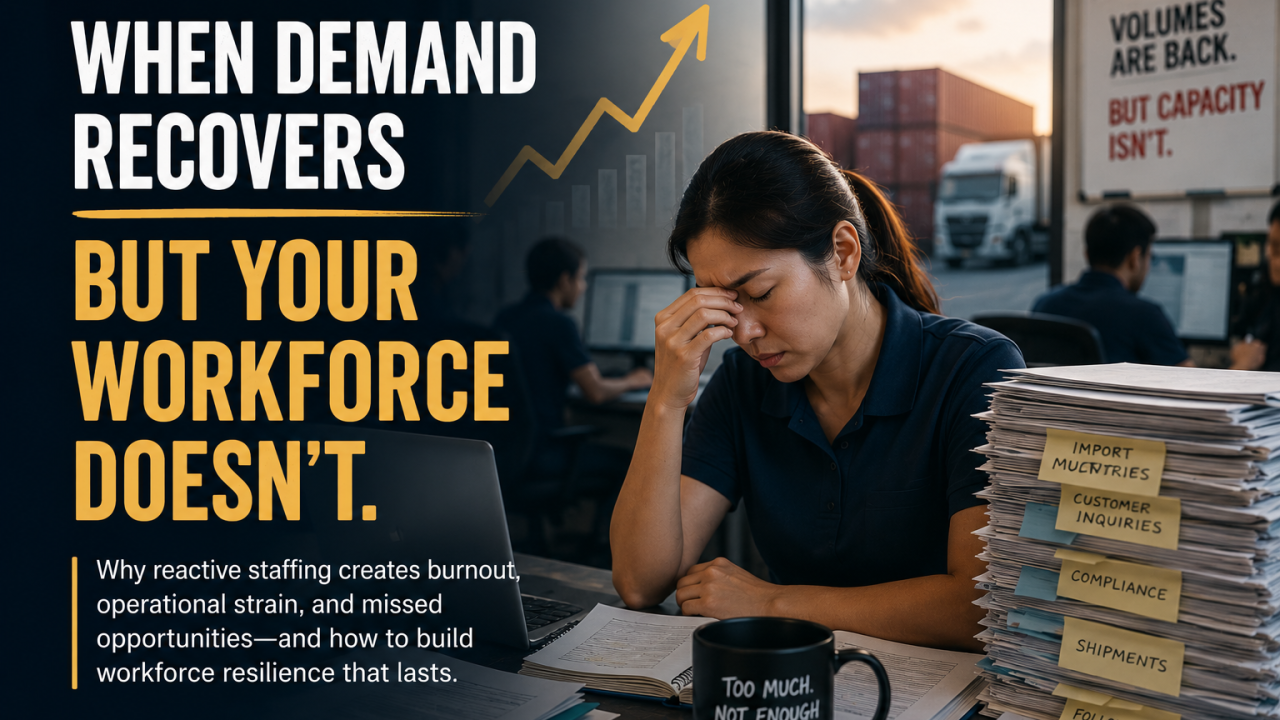
The logistics industry is no stranger to cycles. One quarter, volumes are down. The next, freight starts moving again, customers return, orders increase, and Shipments pick up.On paper, that's good news. But for many logistics companies, recovery brings a different challenge: The business has returned. The workforce hasn't.
The Staffing Dilemma
Earlier this year, many companies faced uncertainty. Trade tensions. Tariff concerns. Slower freight volumes. To protect margins, businesses reduced costs. For some, that meant reducing headcount.
At the time, the decision may have made operational and financial sense. However, the challenge appears later when demand returns faster than expected.
When Volume Returns, Capacity Doesn't
Unlike equipment, people cannot be scaled overnight. When business improves, companies often discover:◆Experienced staff are gone◆Institutional knowledge has left◆Recruitment takes time◆Training takes longerMeanwhile, customer expectations remain unchanged.
The result? The remaining team absorbs the pressure.
The Hidden Signs of an Overstretched Operation
Burnout rarely announces itself. It rather appears as:More mistakesSlower response timesMissed follow-upsIncreased frustrationGrowing absenteeismRising turnoverAt first, teams compensate through effort. But effort is not a sustainable operating model.
A Relatable Logistics Scenario
Imagine a custom and import operation. During a market slowdown, staffing is reduced. Months later, import volumes begin rising again, and suddenly the remaining team is handling:More entriesMore customer inquiriesMore compliance requirementsMore shipment exceptionsThe same number of hours, the same number of people, and eventually something gives. Not because the team lacks commitment, but because capacity has limits.
The Cost Companies Often Miss
Most organizations calculate the savings from layoffs. Fewer calculate the costs of recovery.
These include:Delayed serviceLost productivityRecruiting costsTraining costsCustomer dissatisfactionEmployee turnoverA company may save on payroll in one quarter, only to lose far more through operational strain in the next.
Why Reactive Staffing Creates Instability
The problem is not workforce reduction itself. The problem is making workforce decisions based solely on current volume.
Logistics markets are dynamic and conditions change quickly. When staffing strategy only reacts to today's demand, organizations become vulnerable to tomorrow's recovery.
What Resilient Companies Do Differently
The strongest operations treat workforce planning as a strategic capability.They focus on:1.Cross-training: Employees can support multiple functions when demand shifts.2.Flexible labor models: Temporary support can absorb short-term surges.3.Workforce forecasting: Staffing decisions consider future scenarios, not just current volumes.4.Process improvement: Automation and workflow optimization reduce pressure before additional hiring becomes necessary.
The Leadership Challenge
Leaders face difficult decisions during downturns. Nobody wants excess cost. But nobody also benefits from a burned-out workforce either.
The goal is not simply reducing labor costs, but preserving operational capability because when demand returns, capability becomes the most valuable asset in the business.
The Strategic Shift
For years, logistics companies optimized:AssetsRoutesWarehousesTransportation networksIncreasingly, they must also optimize workforce resilience, because trucks don't experience burnout, and systems don't become overwhelmed. But people do. And workforce remain the foundation of every successful logistics operation.
Final Thought
Market slowdowns come and go. Trade disputes eventually ease, and volumes eventually recover. But rebuilding a depleted team takes far longer than rebuilding a freight pipeline.
The companies that navigate industry cycles best are not necessarily the ones that cut the deepest during downturns. They are the ones that emerge from recovery with a workforce still capable of carrying the load.
Enjoyed this nugget?
Explore more freight-tested insights and logistics stories.